
As you walk through the Park, have you ever wondered where those stone walls or steps came from? Piedmont Park has a rich history spanning over the course of nearly two centuries. Since 1822, Piedmont Park has continuously evolved, changed hands, and underwent several transformations. It first began as a forest, then a farm, then a fairground and suburban park, and finally to the urban park that it is today.
Check out our free, guided history tours by the Piedmont Park Conservancy.
LAND ACKNOWLEDGEMENT & STEWARDSHIP
We acknowledge the Muscogee (Creek) people who lived, worked, produced knowledge on and nurtured the land where Piedmont Park is now located. The Muscogee were forced to relinquish this land through violence and governmental policies in 1821, thirteen years before this land’s first European ownership. We seek to honor the Muscogee Nation and other Indigenous caretakers of this land by humbly seeking knowledge of their histories and committing to respectful stewardship of this land.
HISTORY OF PIEDMONT PARK
From Forest to Farm
- Piedmont Park was initially a forest
- In 1834, Samuel and Sarah Walker, among the area’s pioneer settlers, purchased the land for $450
- Walkers built a cabin on what is now the Active Oval, cleared the trees, and transformed it into farmland
- In 1857, their son Benjamin Walker purchased the farm from his father and settled into a new log cabin where the Piedmont Driving Club is located today
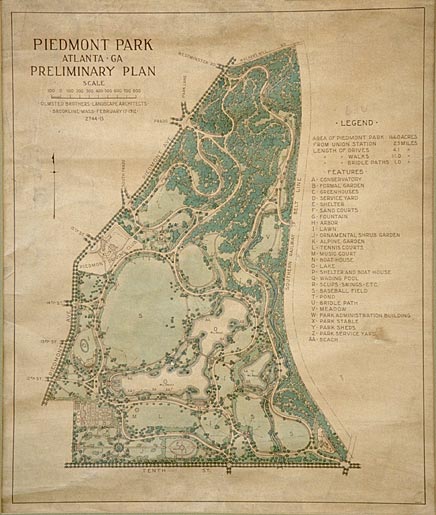 In 1909, the City elected to transform the decaying fairgrounds into a park and enlisted Olmsted Brothers, pre-eminent landscape architects of the time, (and sons of Frederick Law Olmsted), to develop a master plan for the park. Due to budget limitations, their plan for Piedmont Park was not fully implemented. Nevertheless, the Olmsted Brothers’ 1912 plan greatly influenced the development of Piedmont Park. In fact, the current master plan, adopted by the City of Atlanta and Piedmont Park Conservancy in 1995, honors the brothers’ original vision for the park.