Celebrating 15 Years of Fresh Produce at Green Market

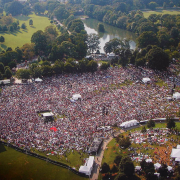
Imagine, it’s a beautiful Saturday morning in April where the trees blossom and the birds sing. On this day, the Piedmont Park Conservancy introduces the Green Market to the public as part of its Centennial Celebration. Crowds of people stare in amazement as they await the unveiling. This is the start of something new.

We are proud to commemorate 15 years of Green Market at Piedmont Park. The Conservancy first introduced the Green Market on April 17, 2004 in partnership with the City of Atlanta Bureau of Cultural Affairs. As a key sponsor and supporter of the program, Kaiser Permanente greatly contributed to the Green Market’s success over the years. Since its debut, the program has influenced the diet and lifestyle of millions of visitors in the heart of Atlanta. 

In the beginning, the Green Market featured high quality, locally-grown produce, prepared goods, flowers, herbs and other specialty items. The program included chef demonstrations designed to showcase how fresh produce could be prepared at home and live music from local bands as entertainment. Now, the Green Market has board-certified dietitians who guide guests in their path of health and nutrition while utilizing market produce. Also, there is a kid-friendly activity center for guests with small children.

 “Green Market gives walkable access to local fresh produce, meat, baked goods and more. How amazing is it to walk out your door on a Saturday morning and do your shopping in one location?!” said Green Market Manager Mary Yetter.

Over the past decade, the staff at the Conservancy have played an integral part in the development of the Green Market. The program has been voted one of the top five farmer’s markets in Atlanta by Access Atlanta, and is currently available on Saturdays, March 30 – November from 9am to 1pm at 12th Street entrance.

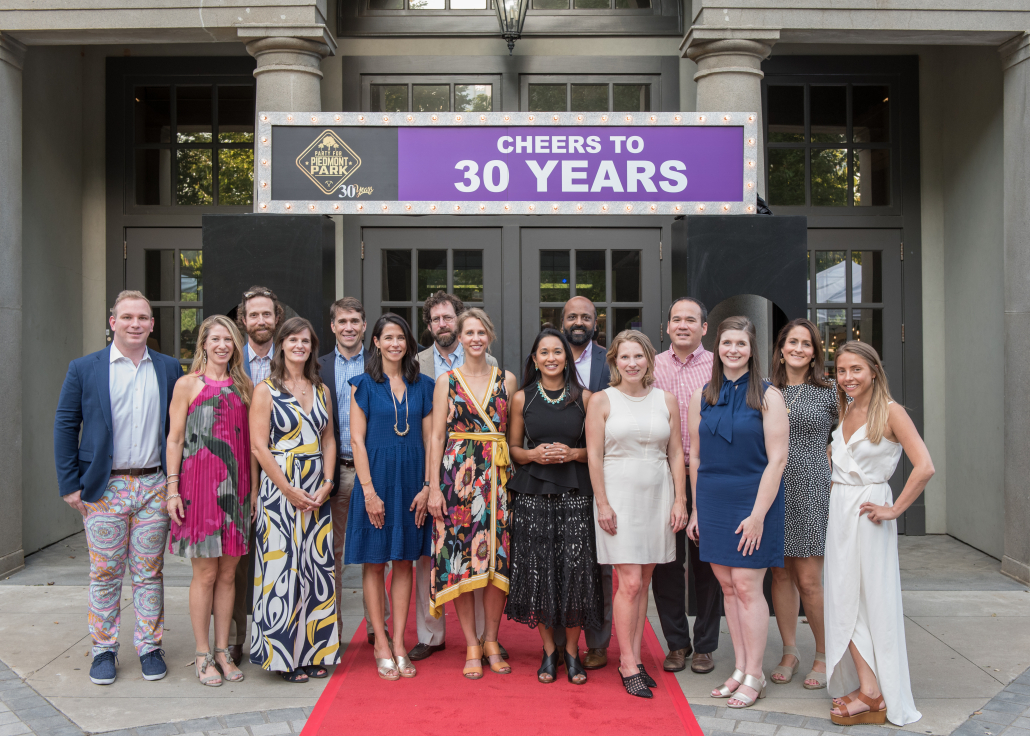
In response to this momentous occasion, the Conservancy is hosting a party to celebrate Green Market’s 15th anniversary. Save the date for September 21, 2019.

This blog is in memory of Carrie Jennison, who helped establish the Green Market.

Author: Amari Woods

Ilyssa and Mike: The Perfect Wedding Destination

Piedmont Park is more than Atlanta’s playground, it’s where memories are made.

Ilyssa and Mike first met through a mutual friend at a bar. A few drinks and laughs later, Ilyssa knew she was interested in Mike. From there, the rest is history.

With marriage quickly approaching, the couple needed to find the perfect location. They loved nature and spent a lot of time in New York City’s parks while dating. Mike even proposed at a park! “So in choosing a venue, Piedmont Park was the perfect place – a beautiful park in the middle of the city with lots of natural beauty all around,” said Ilyssa.

What was your favorite part of your wedding?

“Every single part of our wedding was complete magical!! If I had to choose one part, I think I would say the beginning of the wedding at Dockside: the bridal reception and ceremony. These parts were both outside with the beautiful lake in the background, the weather was perfect and it just felt so enclosed by so much stunning natural beauty,” Ilyssa stated.

Dockside is one of Piedmont Park’s most popular wedding venues. With vast trees and a stunning lake, this location is great for any romantic occasion!

The couple invited their closest family and friends to witness their union at this scenic location.

 What was it like to work with Piedmont Park Conservancy staff?

“It was a great experience working with Jane from Piedmont Park! She was always super helpful and attentive from the moment we started considering the venue to after the wedding too,” she said.

The staff at the Conservancy are dedicated to making each experience magical.

As the Director of Facility Rentals, Jane Rollo is responsible for answering any facility questions guests may have, especially the bride and groom. She assisted in making their wedding day special.

Will Piedmont Park play a role in your married life?

“Of course! We actually plan to move to Atlanta this summer and we cannot wait to spend as much time as we can walking, playing, picnicking and of course reminiscing in the park! We also hope to get a pup soon and look forward to bringing the dog to the Piedmont Park Dog Parks too,” she exclaimed.

The Piedmont Park Conservancy is grateful to be a part of this wonderful journey that Ilyssa and Mike will remember for the rest of their lives.

“If you are looking for a beautiful, natural venue in the heart of Atlanta, this is your place!! Highly recommended,” said Ilyssa. 

For more information about reserving one of our venues, or if you would like a tour of our venues, please visit: piedmontpark.org/weddings

Photo credit: The Decisive Moment

Author: Amari Woods

https://www.thedecisivemoment.com/

If It Walks Like A Duck

While walking around Lake Clara Meer, you’ve probably noticed ducks either swimming in the lake or hanging out on its banks. Have you ever wondered about the different types of ducks that inhabit the park and when during the year you can find them here?

In fact, more than 10 different types of ducks can be found in Piedmont Park, few of which actually have the word duck in their name.  Listed below are the formal names of ducks you can see during your visit to the park along with descriptive information about each type.  After the duck’s name is the time of year that each has been observed here.

Muscovy Duck (year-round)

With their long necks, heavy bodies, webbed feet and spatula-shaped bills, these birds are instantly recognizable as ducks but there are many clues that help Muscovy ducks stand out from the flock. Their relatively long bill is dark at the base with variable color bands along its length, including white, pale blue-white, and pink, and the nail at the bill’s tip is gray.  Even though the word Muscovy means “from Moscow”, these ducks are not from Moscow.

Ruddy Duck (January)

The ruddy duck is a species of stifftail duck (others include the masked duck and blue-billed duck) and is a diving duck with a spiky stiff tail which is used as a rudder while swimming.  The tail may also be held angled or vertically as a breeding or territorial display especially between competing males.  These ducks often have colorful bills and compact bodies.

Ring-necked Duck (November through April)

The ring-necked duck is a small to medium-sized diving duck that has two white rings surrounding its gray bill, a shiny black angular head, black back, white line on its wings, a white breast and yellow eyes.  The female has a grayish brown angular head and body with a dark brown back, a dark bill with a more subtle light band than the male, grayish-blue feet and brown eyes with white rings surrounding them. This duck is sometimes referred to as a ringbill.

Wood Duck (year-round)

The wood duck or Carolina duck is one of the most colorful North American waterfowl.  Breeding males exhibit ornate, colorful patterns visible up-close but appear dark overall at a distance; females are gray-brown with a thin white ring around the eye.  The wood duck possesses a crest on its head and flies through trees with exceptional maneuverability thanks to its long tail.  Often shy and quick, the wood duck’s call is a loud, screeching whistle.

Mallard (year-round)

Mallards are large ducks with hefty bodies, rounded heads and wide, flat bills.  The mallard’s body is long and the tail rides high out of the water, giving a blunt shape.  Male mallards have a dark, iridescent-green head and bright yellow bill.  The gray body is sandwiched between a brown breast and black rear.  Females and juveniles are brown with orange-and-brown bills. Both sexes have a white-bordered, blue patch on their wings.

Redhead (March)

The redhead goes by many names including the red-headed duck and is easily distinguished from other ducks by the male’s copper-colored head and bright blue bill during the breeding season.  Slightly larger than a ring-necked duck and slightly smaller than a canvasback, the redhead is a medium-sized diving duck with a smoothly rounded head and a moderately large bill.  Redheads have black-tipped, gray bills, and in flight they show gray flight feathers.

Canvasback (December & January)

The canvasback is the largest species of diving duck in North America measuring up to 22 inches in length and weighing up to 3.5 pounds.  The canvasback has a distinctive wedge-shaped head and long graceful neck.  Its sloping profile distinguishes it from other ducks.  Both male and female have a black bill; the male has a chestnut red head and neck while the female has a light brown head and neck.  The canvasback’s legs and feet are bluish-gray.

Northern Shoveler (Spring & Fall)

Appropriately nicknamed the spoonbill, the northern shoveler has the largest bill of any duck in North America. The bill is actually longer than the duck’s head with a flattened wide tip perfect for “shoveling” along the water’s surface for food.  Males have an iridescent green head; females are brown, buff and black with darker upperparts, finer streaking on the head and a faint dark eye line.  Both genders have yellow eyes, and bright orange legs and feet.

Blue-winged Teal (Spring & Fall)

There are more than 20 species of teal ducks throughout the world.  The blue-winged teal is a smaller, petite duck characterized by its short neck and short tail.  Males have brightly marked, distinctive plumage.  The unexpected shades may be difficult to see when the bird’s wings are folded but very colorful when in flight.  Females are more camouflaged with muted, earth tone colors which serve as protection while they are nesting or caring for young ducklings.

Lesser Scaup (January & March)

The lesser scaup is a medium-sized diving duck, smaller than the closely-related greater scaup, with a small peak at the back of the head.  It is colloquially known as the little bluebill or broadbill because of its distinctive blue bill. The lesser scaup is one of the most numerous and widespread diving ducks in North America.  Its name, scaup, may stem from the bird’s preference for feeding on scalp—the Scottish word for clams, oysters and mussels.

Bufflehead (February through April)

Adult males are striking black and white with iridescent green and purple heads and a large white patch behind the eye.  Females are gray-toned with a smaller white patch behind the eye and a light underside.  The bufflehead rivals the green-winged teal as the smallest American duck, measuring under 16 inches long and weighing under 20 oz.  Its name refers to its head shape, noticeable when the male puffs out the feathers on its head, greatly increasing its size.

Hooded Merganser (November & December)

The most prominent feature of this small, slim, streamlined duck is its narrow, serrated, hooked bill.  The merganser is the only type of duck that regularly eats a large amount of fish and similar prey, and its bill is specialized to make this duck a keen and ferocious hunter.  Two other species of this duck includes the common and the red-breasted merganser.

Piedmont Park Ducks – Do’s & Don’ts

Do’s

  • Only offer foods in bite-sized pieces the ducks can easily consume without choking or struggling.
  • Good foods for ducks include bite-sized pieces of apples and tomatoes, cracked corn, chopped kale, bite-sized pieces of romaine lettuce or Swiss chard and watermelon
  • Enjoy the experience of being in nature with these colorful birds

Don’ts

  • Don’t feed bread to the ducks; it’s not good for them
  • Do not allow pets or children to chase or disturb the ducks
  • Stop feeding if the ducks appear uninterested or are leaving the food uneaten, and avoid feeding the ducks if other visitors are already offering treats

Guest Post by Don Disner

AUTHOR’S BIO: Don Disner

Move over Weeds, We ‘Goat’ This

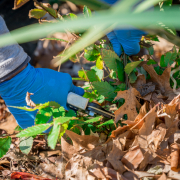
What’s goating on here? If you’ve been to Piedmont Park recently, you may have spotted goats! No need to worry-they are here on purpose. In an effort to clear the Park of overgrown shrubs and invasive species, the Piedmont Park Conservancy introduced goats as a more organic, sustainable option.

We had fun following the goats on their journey!

When the goats first arrived at Piedmont Park, many guests were thrilled to see them. Look at those horns!

All types of goats were used to help with this restoration project. Mostly, the goats were either Boar or Kikos.

The goats were free to eat as much grass as their four stomachs could take. They eat approximately five to seven pounds a day!

Also, there are dogs! Although the goats were fenced in, these two siblings made sure they had extra protection. Meet Bowie and Trudy.

Strike a pose! Who knew goats were so photogenic? We captured this quick picture while the goats were on a break.

Drink up! The goats frequently stopped for water after being in the sun.

Thanks to Get Your Goat Rentals for helping with our restoration efforts!

Author: Amari Woods

Piedmont Park Conservancy Hosts Staff CPR Training and Installs AEDs

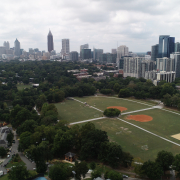
On an early spring day, a Park visitor was playing soccer on the Active Oval when he suddenly fell to the ground. He was experiencing a major heart attack at just over 30 years old. Luckily, his friends were medical professionals and thought to run to the Tennis Center for help. They found an automated external defibrillator (AED) device which they used to keep his heart beating while they waited for an ambulance.

With over 78,000 athletes coming to Piedmont Park every year, things happen. Medical emergencies, on the other hand, are few and far between. The incident prompted the Conservancy staff to explore how they could respond to similar situations while working in the Park.

The Piedmont Park Conservancy was accepted into the Community Foundation for Greater Atlanta’s 2018 Fall Extra Wish catalogue, where two generous donors provided the funding for three new AED devices. Additionally, the Conservancy decided to host two CPR training courses for the staff. The inclusion of the extra AED devices and staff training empowers the Piedmont Park Conservancy to provide assistance in a situation that may arise during their daily operations.

As of May 2019, over 80% of the Piedmont Park Conservancy staff has been trained on how to perform CPR and use an AED device. Mark Banta, President and CEO of the Conservancy, said of the training, “While there are no guarantees in life, the survival rate of sudden cardiac arrest with the use of an AED device increases to about 40% or higher as opposed to 5%. We’re thrilled to have received this equipment and training in an attempt to improve the chances of survival.”

We hope to continue providing a gathering place for all Atlantans because we believe that a healthy and sustainable Park greatly contributes to a healthy and sustainable Atlanta.

Reminder: Always call 911 in case of emergency. After calling 911, if you see a Piedmont Park Conservancy staff member during working hours, please notify them of your emergency.

Stop and Listen to the Birds Sing

If you’ve ever walked through Piedmont Park on a gorgeous spring day, you’ve likely been surrounded by the songs of more bird species than you realized were there. Before moving to Atlanta nine years ago, I could identify maybe five common songbirds and a few birds of prey, probably the same ones everyone knows. Though it’s nothing compared to dedicated birders, ornithologists, or even semi-serious hobbyists, I can easily ID three dozen or so now.

I’ve been lucky; most of my bird knowledge came to me through the grace of others- Books gifted from friends and family, bits of knowledge gleaned from birders, photographers, and friends who know more than me. Gray and brown birds on my home feeders, once lost in the fray, now stand out as chipping sparrows, house finches, brown-headed nuthatches, and several others.

Now I cannot help but notice dozens of species of birds when I’m outside. For me, lack of knowledge was a symptom of a lack of observation, and changing that behavior opened me up to an entire world.

Working in Piedmont Park, I take in as much as I can in between tasks, but as a park visitor you have the chance to sit back and observe. I strongly recommend you take advantage of sitting down on a bench, looking, listening, and noticing the birds. See if you can start picking them out by their call or colors.

Carolina Wren

With all that’s going on in our lives, it’s easy to inadvertently ignore all the different species of birds around you. For instance, the Carolina Wren as he, (only the males of the species sing) sings in a voice too big for his body. No doubt, if you live almost anywhere in the southeast, you have heard this call, but could you identify the wren by his song? If you saw him, would you recognize the shape of his body, upright tail, the white “eyebrow” line, or his thin, curving beak? These details, relied upon by birders, can easily go unnoticed unless we stop to see them.

Pileated Woodpecker

Over the sound of chirps, whistles, and trills, you may hear a distinct knocking on wood. A woodpecker will hammer on a tree in search of insects for lunch, or dig a hollow for a nest. If you can spot them, you’ll notice that they’re all some variation of black and white, usually with degrees of red on their heads. With the common downy woodpecker, a small red mark is a defining characteristic of the male. See the relatively large red bellied woodpecker, and you’ll likely wonder why it’s called that, since its bright head is redder than its belly. Let’s not forget the most famous (and largest) woodpecker, the pileated. The pileated woodpecker can be elusive, but you might find one feasting on grubs from a rotted tree trunk.

Brown Thrasher

Spring and fall turn the park into a hotbed for migratory birds avoiding harsh northern winters or revisiting breeding grounds, which creates great opportunity for interesting sightings. We have the easily recognizable northern cardinal, vibrant red (the females are more pinkish brown) with its bright orange beak, the American robin, foraging for worms on the ground in groups with their rusty orange chests and white rings around their eyes, and our friend from earlier, the Carolina wren. The northern mockingbird, a particularly vocal gray songster, can spout a dozen tunes in the span of a minute. They can have hundreds of songs in their repertoire, but our Georgia state bird, the brown thrasher, can have over a thousand!

American Robin

With the noise of civilization around us, birds provide a natural, meditative escape through their songs, their call and response, and variety in countless species. Whether or not you desire to know them all by name, or if you just want to enjoy their songs and observe their behavior, I sincerely hope that you take the  time (and now’s a good time to do it) to ignore everything else and focus on our feathered friends for a bit- watch, listen and be humbled by them. Learn a little or a lot, you’ll be richer for the experience- I promise.

Want to learn more about bird life in Piedmont Park? Sign up for one of our bird walks! https://piedmontpark.org/sightseeing-and-tours/

Author: Michael Paul

Photo Credits: Kevin Gaston

A Look Inside the Colorful World of Piedmont Park’s Spring Blooms

Spring is in full swing at Piedmont Park. The air is filled with fragrant and bountiful blooms that create a non-stop show. A green sanctuary in the middle of Atlanta, the Park is home to a diversity of trees that provide not only beauty, but habitat for hundreds of pollinators including bees, butterflies, birds and other critters that live in the Park.

From majestic oaks to diminutive dogwoods, these trees, shrubs, perennials and annuals also provide visitors with four seasons of color and a green oasis to enjoy throughout the year.

And if you’re inspired you may want to try growing some of these plants in your own garden.

Below is a list of garden-worthy plants to consider. Both the common and botanical names are listed so that if you are shopping for plants then you will know what to ask for.

Dogwoods, a favorite spring bloomer at Piedmont Park

Autumn Fern- Dryopteris erythrosora: This exotic ornamental makes itself right at home in southern gardens. The new growth emerges with bronzy tinges before it turns green which remind some of autumn.

Carolina Silverbell- Halesia carolina: This native small to medium sized flowering tree displays beautiful white bell shaped flowers. Full sun or part shade.

Carolina Silverbell, a great native plant with striking flowers.

Dogwood- Cornus florida: There are hundreds of native dogwoods growing throughout the park, easily recognizable by their beautiful white bracts in spring. The red fall fruits and red leaf color make it a standout in the fall.

Fringe Tree- Chionanthus virginicus: This native flowering tree produces masses of fleecy white flowers in spring.

Hellebore- Helleborus x hybrida, also known as Lenten roses: This evergreen groundcover blooms in late winter to early spring.

Native azaleas fill the air with their sweet perfume.

Native Azaleas- Rhododendron spp. including R. austrinum, and  R. canescens: bloom over a period of months beginning in early spring and continuing until late summer.

Redbuds- Cercis canadensis: is a small flowering tree with distinct lavender-pink flowers that appear before the heart shaped leaves.

Redbud flowers appear before the leaves emerge in spring.

White Oak- Quercus alba: This majestic native gets better and better with age. Be sure to give this beauty plenty of space as it becomes a large tree growing to heights of 50 to 80 feet tall, or more.  Oakleaf Hydrangeas-Hydrangea quercifolia- The leaves remind some of oak trees and the large white flowers standout in the landscape.

Want to do more for Piedmont Park’s plant life? Visit piedmontpark.org/support-the-park/commemorative-donations/ and learn how to plant your very own tree!

Author: Erica Glasener

Piedmont Park: A Place for Friends

Are you looking for a place to make new friends or new memories? Come on over to Piedmont Park and experience life in Atlanta’s favorite park! Piedmont Park is a bustling urban green space and full of life every day. Here are just a few ways you can get involved!

1) The Active Oval: The Active Oval is a staple of Piedmont Park and one of the best places to meet new people. Many different intramural sports teams reserve the space for their games, and there’s always room for another player. It also has a full track and fitness equipment, making it a great place to get your workout in!

2) Free Yoga on the Promenade: Every fourth Monday of the month, Piedmont Park offers a free yoga class on the Promenade. Grab your mat and head over because you’re bound to meet a ton of great people and maybe even find that workout buddy you’ve been searching for!

3) Picnics in the Park: Picnics in Piedmont Park are very popular among Atlantans and one of the best ways to spend a Sunday afternoon in the city. Pack your favorite snacks, round up your favorite people, and pick one of the many scenic spots in Piedmont Park to kick back and enjoy each other’s company!

4) Green Market: Every Saturday from 9:00 AM-1:00 PM, Piedmont Park hosts the Green Market, a local farmers market dedicated to bringing locally sourced produce to the Atlanta community. Start your Saturday right and come out to enjoy the incredible food trucks, unbeatably fresh produce, and captivating live music at one of Midtown’s favorite farmers markets!

5) Dog Parks: The Piedmont Park Dog Parks are one of the most utilized spaces at the Park. Grab your four-legged friends and check out our off-leash parks. Locals frequent the dog parks, making it one of the best places to meet new people. Not only will you meet dozens of your neighbors but even your pup will find a furry friend!

Whether you’re looking to get active, or looking for a spot to relax, Piedmont Park has a place for you! Piedmont Park welcomes everybody and is the perfect place to engage with your new community or to make memories with your friends!

Follow Piedmont Park on Instagram @piedmontpark to see more of what life is like inside the Park!

Author: Olivia Gage

Spotlight: MindBody at Piedmont Park

With its signature mix of natural aesthetics, historic beauty, and modern interiors, Piedmont Park’s Greystone was the perfect setting for MindBody and their 2019 Regional Sales Kick Off. The wellness-focused tech company learned about Piedmont Park’s Conservancy venues from their marketing team and were quick to secure their winter date.

This was a big meeting for MindBody. The event would both recap the East Coast Sales team on 2018 accomplishments, as well as showcase goals and upcoming changes for 2019. Tina Palmer, West Coast Sales Administrative Assistant, lead the planning and coordination. She needed a venue that could go the extra mile to help her host a successful event from out of state.

“Chelsea Dahl was my favorite! Planning events from across the country is extremely difficult, but Chelsea made it seemingly easy. Since I had never seen or used the venue before, she was my eyes and ears. Throughout the entire event planning process, she was helpful and accommodating and was able to adapt our many changes before and during our event!”

- Tina Palmer

The event went off without a hitch! Golf cart shuttles began early in the morning, bringing visitors on a short ride through the Park to the venue. Upon arrival, guests enjoyed breakfast fare by Carlyle’s Catering and sipped coffee while admiring the views of Lake Clara Meer from Greystone’s waterfront terrace.

“The views were GORGEOUS, and the building was unique and historical! The Piedmont Park Conservancy staff was extremely helpful and easy to work with,” says Palmer. “My team LOVED Piedmont Park! They were very impressed with the views and history behind the venue.”

MindBody normally hosts sales-related events such as kickoffs, company training sessions, team building activities, and happy hours. When asked if they would return to Piedmont Park for an event, Palmer replied “Yes, I would love to come back! The Piedmont Park Conservancy was very easy to work with and made destination planning very easy.”

To begin planning your event at Piedmont Park, contact Chelsea Dahl at [email protected] or call (404) 537-2831. Also, visit our the corporate event webpage at https://piedmontpark.org/corporate/

Exploring Piedmont Park’s Northwoods

One of Atlanta’s best features is its easy access to incredible outdoor experiences in the Appalachians. For this reason, many of us can’t imagine living in a city without a short drive to abundant natural space. But for those who feel a lot more relaxed outside, midweek in the city can start to feel a little too cramped. Luckily, you don’t have to wait for the weekend!

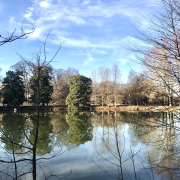
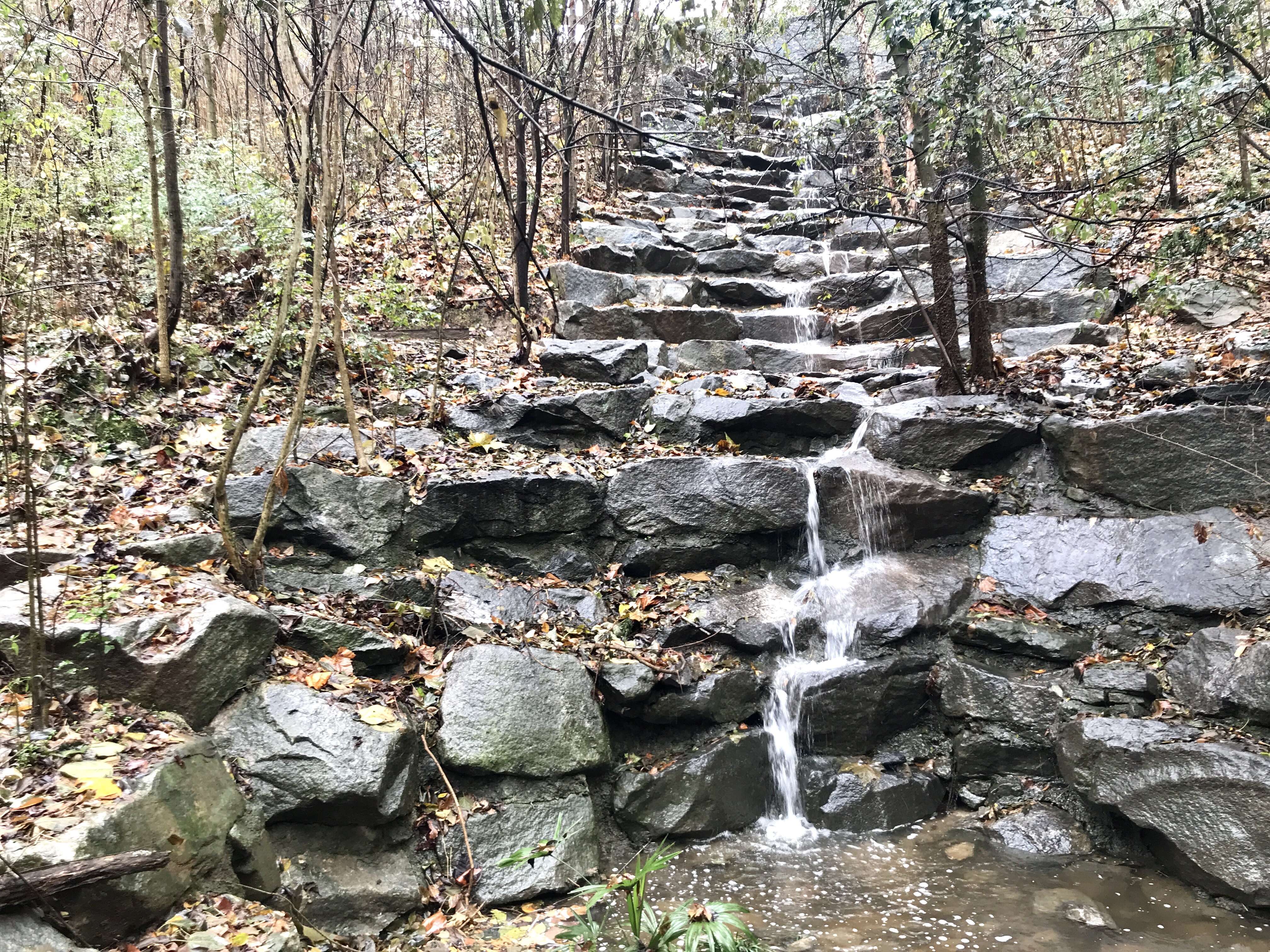
You are probably familiar with Piedmont Park’s popular destinations like the Meadow, or the Dog Parks, and all 200 plus acres of the Park are great places to spend some time outdoors. Just north of those locations, though, the paths lead you through a tucked away tree lined expansion to the Park. This is over 53 acres added in 2011 that boast nature trails and conservation areas, Legacy Fountain, the Northwoods, and the Piedmont Commons. After a brief foray down these paths you’re sure to find your breathing calmed and eyes open to the chirping birds, rustling chipmunks, and all the colors of life. Here are some amazing views in the Piedmont Park expansion that feel miles away from the city.

Where better in the Park to sit and read or write for an hour, or two, or three or four? You don’t get the distractions of festivals out here, just the ambient sounds of nature and the words on the page!

A short walk past the Conservancy offices is the Promenade Lawn, a beautiful clearing on a plateau in the treetops to the east.

A look at forest serenity, but only a stone’s throw from your door! Find the wooden staircase in the Walker Woods for these unpaved views.

Straight outta Narnia, you find yourself on the other side of the wardrobe in the Northwoods’ forested paths.

Author: William Lange